It's 4:30 PM. The sales manager looks at his dashboard. The opportunities are there, quotes have been sent, meetings have taken place. Yet, several files are stagnating. No clear refusal, no yes either. Just silence. This silence, in many SMEs, costs much more than one might think.
In many cases, this invisible cost is directly linked to insufficient or poorly structured customer follow-up, even when opportunities seem well-engaged.
Customer follow-up is often perceived as a secondary task, almost administrative. One more email. One call to reschedule. Something we'll do "when we have time". In reality, customer follow-up is one of the most strategic levers of the sales process. It is often what makes the difference between a lost opportunity and a closed sale.
In a context where potential customers are solicited from everywhere, not following up amounts to voluntarily disappearing from the radar, even after a promising first meeting.
Customer follow-up is not harassment, it's professionalism
Many salespeople hesitate to follow up for fear of bothering. They tell themselves that the customer will call back if they are truly interested. In fact, this scenario rarely happens. Not because the customer isn't interested, but because they are busy, distracted, or caught up in their own emergencies.
Good customer follow-up doesn't put pressure. It reassures. It demonstrates that the salesperson is present, structured, and genuinely concerned about the customer's situation. It's a clear message that says: I'm not just trying to sell you something, I'm accompanying you in your decision.
In many cases, the customer is exactly waiting for this follow-up to move forward. They want clarification, confirmation, or sometimes simply to feel supported before committing.
The line between follow-up and harassment is not about frequency, it's about value. Sending "just checking in" three times in the same week is pressure. Bringing something new each time is a service: a relevant case study, an answer to an objection raised during the meeting, or a deadline tied to the customer's own timeline. A useful rule of thumb is that every follow-up should give the customer a reason to reply, not simply remind them that you are waiting.
Where the majority of sales are lost
In many organizations, efforts are concentrated on acquisition. Generating leads, filling the calendar, making presentations. That's important, obviously. But a large part of lost sales is not due to a lack of opportunities. They are lost due to a lack of commercial follow-up.
A potential customer meets a salesperson, shows interest, receives a proposal, then nothing happens. The file falls between two busy weeks, a change in priority, or a salesperson who tells themselves they'll follow up "later".
Meanwhile, the customer compares, hesitates, or is approached by a competitor who is more rigorous in their follow-ups. Not necessarily better. Just more present.
In a B2B sales context, structured customer follow-up often allows unlocking already qualified opportunities without generating a single additional lead. A well-designed client closing process turns these stalled deals into signed contracts by ensuring no opportunity falls through the cracks.
A simple follow-up cadence you can reuse
Most stalled deals don't need a clever tactic, they need a predictable rhythm. For a typical mid-sized B2B opportunity, a cadence that works often looks like this:
- Same day: send a short written recap of the meeting, the agreed next step, and the proposal or timeline. This anchors the conversation while it's still fresh.
- Day 2 or 3: confirm the quote was received and offer to walk through any point. A quick call often works better than another email here.
- Day 7: bring new value, such as a relevant case, an answer to an objection, or a clarification. Never a bare reminder.
- Day 14: propose a concrete decision date or a short call to close the loop, giving the customer an easy way to say where things stand.
- Day 30 and beyond: if there is still no decision, move to a lighter, longer-interval nurture rhythm rather than abandoning the file entirely.
The exact days matter less than the principle: each touch is planned, spaced, and carries a reason to respond.
Customer follow-up as a trust lever
Trust is not built only during the initial meeting. It is built in consistency. Every well-done follow-up reinforces the credibility of the salesperson and the company. It shows that commitments are respected, deadlines are followed, and the relationship doesn't stop at the potential signature.
For an SME owner or a sales manager, setting up a clear and repeated customer follow-up process is also a way to standardize the quality of the customer experience. No matter the salesperson, the customer feels they are being taken care of professionally.
Over time, this rigor becomes a competitive advantage. Customers notice it, even unconsciously.
Post-sale follow-up, an all too often forgotten reflex
A frequent mistake is to stop following up once the sale is concluded. Yet, post-sale customer follow-up is often where the relationship truly begins. A customer who feels followed up on after the purchase is much more likely to remain loyal, buy again, and recommend the company.
A call a few days after delivery, a message to validate satisfaction, or checking in after a service implementation makes all the difference. These are simple but powerful gestures that transform a transaction into a lasting business relationship.
In the long run, these follow-ups reduce churn, increase customer lifetime value, and naturally fuel referrals.
Structuring follow-ups for real impact
The problem is not that teams don't want to do follow-ups. It's often that they rely on memory, personal notes, or goodwill. As a result, follow-ups are uneven, forgotten, or done too late.
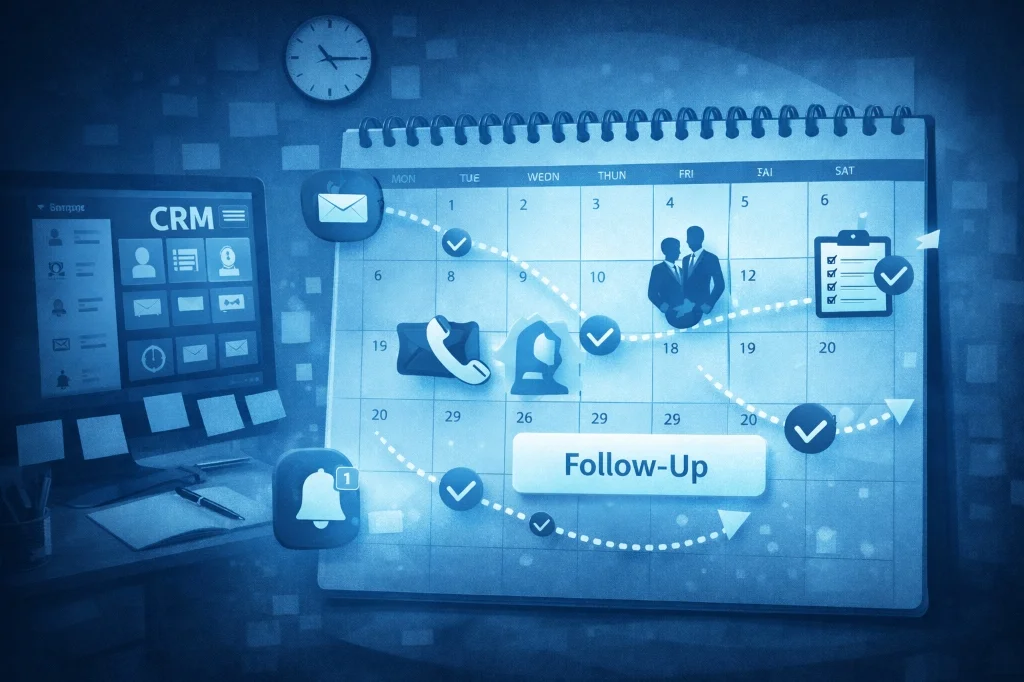
Companies that perform well in sales have understood one essential thing: customer follow-up must be a process, not an improvisation. Whether supported by a CRM, automated reminders, or simple follow-up sequences, the important thing is that it is clear, measurable, and integrated into the daily life of the sales team.
To know whether follow-up is actually working, a few simple signals are worth watching:
- Follow-up rate: the share of open opportunities that received a planned follow-up in the last two weeks.
- Time to first follow-up: how long after a meeting or a quote the first relaunch goes out. The faster, the better.
- Reply rate: whether follow-ups actually generate a response, a good proxy for whether they bring value or just noise.
- Win rate on followed versus forgotten deals: the gap between opportunities with a structured cadence and those left to memory is usually where the lost revenue hides.
Without a tool or a CRM for customer follow-up, even the best intentions end up fading over time. Solutions like AI-powered post-call CRM automation can ensure every interaction is captured and every follow-up is triggered automatically, without relying on manual effort. The automated CRM update feature shows how that work is carried out after every call.
Some industries live or die on that discipline. In real estate, a buyer who is not followed up is a lost listing, which is why broker follow-up and coaching is steered as closely as the sales themselves.
When follow-up becomes a structured reflex, results follow quickly.
Customer follow-up as a culture, not a task
In the end, the importance of customer follow-up goes far beyond the sale itself. It touches the company culture. An organization that values follow-up demonstrates that it respects its customers, their time, and its commitments.
For a leader, investing in better customer follow-ups is investing directly in growth, revenue predictability, and the company's reputation. It's not a waste of time. It's a results multiplier.
And often, it's the companies that follow up better, not those that speak the loudest, that win in the long run.